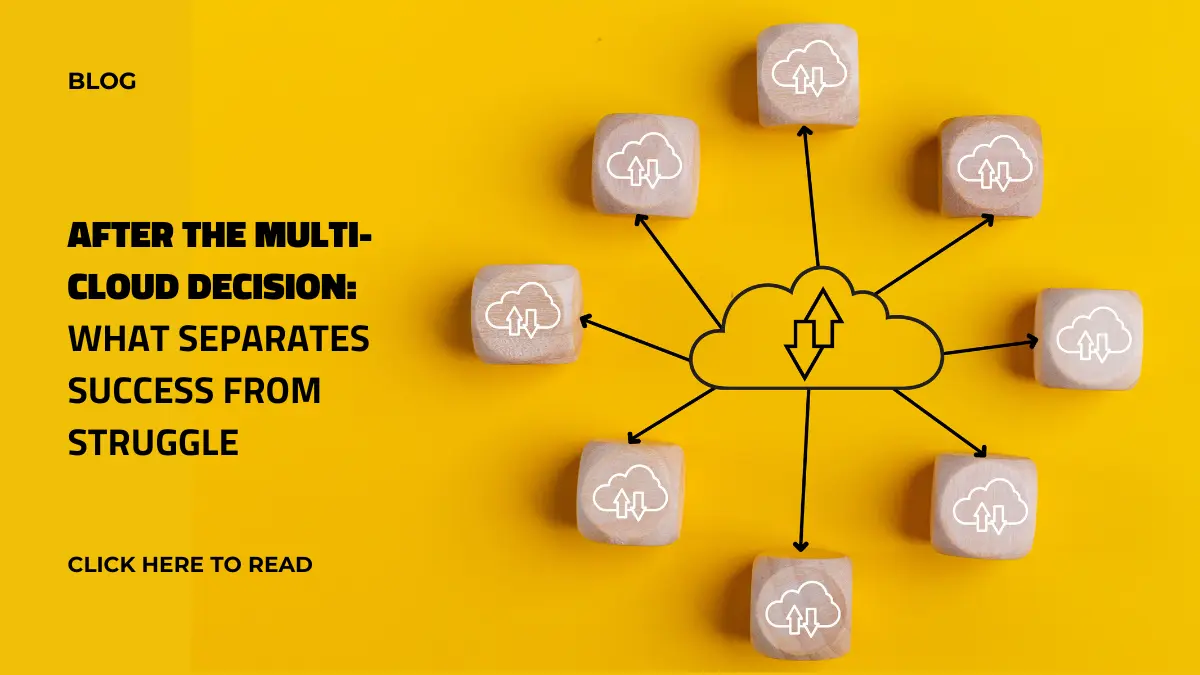
Making a strategic decision to adopt multi-cloud is one thing. Executing it successfully is entirely another.
Organizations that approach multi-cloud as merely “cloud plus more clouds” discover this the hard way—through cost overruns, security gaps, and teams stretched beyond capability. Success requires architectural discipline, organizational transformation, and a fundamentally different operational model.
The Architecture Challenge: Building for Portability Without Compromise
Successful multi-cloud architectures adopt selective abstraction. Mission-critical applications requiring genuine portability receive investment in cloud-agnostic design—containerized, deployed via infrastructure-as-code, with abstraction layers isolating dependencies. Applications where provider lock-in presents acceptable risk leverage native services for optimal performance.
This requires architectural governance, which most organizations lack. Without clear decisions about which workloads warrant portability investment, teams make inconsistent choices, creating technical debt across your cloud estate.
The Skills Gap Nobody Discusses
Finding engineers equally skilled in AWS, Azure, and Google Cloud is exponentially harder than finding single-platform expertise. Networking, identity management, and data services; each provider implements these fundamentally differently. Teams either specialize deeply in one platform or spread expertise thinly across multiple.
Organizations must assign platform ownership to dedicated teams, invest in extensive cross-training, or partner with managed service providers possessing multi-cloud depth.
Cost Management: Beyond Simple TCO
Multi-cloud cost management is a discipline unto itself. Reserved instances committed use discounts, and spot instances—each provider packages these differently. Storage egress, data transfer, and network costs multiply as architecture spans providers.
Enterprises achieving cost discipline implement FinOps practices from day one, real-time visibility, chargeback models, automated alerts, and architectural reviews evaluating total cost implications before deployment.
Security and Compliance Across Platforms
AWS IAM roles, Azure Active Directory, and Google Cloud IAM—each employs distinct permission models. Implementing least-privilege access consistently requires a deep understanding of each platform’s security model.
Achieving SOC 2 or ISO 27001 certification means demonstrating consistent controls across all infrastructure. Organizations must implement tooling to normalize security telemetry or accept platform-specific compliance processes.
How EDCS Accelerates Multi-Cloud Success
Navigating multi-cloud complexity requires expertise that most organizations take years to develop internally. This is where strategic partnership becomes critical.
EDCS brings 16+ years of enterprise cloud transformation experience, with certified expertise across AWS, Azure, and Google Cloud platforms. Our approach addresses the execution challenges that derail multi-cloud initiatives:
Architecture and Migration Excellence: We architect multi-cloud solutions balancing portability with cloud-native optimization, ensuring workload placement aligns with technical requirements and business objectives.
Managed Services and Operational Support: Our ISO 27001-certified managed services provide 24/7 operational excellence across multi-cloud environments, allowing your teams to focus on innovation rather than platform-specific administration.
Cost Optimization: We implement FinOps frameworks, delivering visibility and control across cloud spending, leveraging our provider relationships to optimize licensing and commitment structures.
Security and Compliance: Our security architects design consistent governance frameworks spanning multiple clouds, ensuring compliance requirements are met without operational friction.
SAP and Oracle Integration: As an SAP Silver Partner and Oracle Partner, we uniquely understand how multi-cloud decisions impact mission-critical ERP environments, ensuring seamless integration between enterprise applications and cloud infrastructure.
Ready to Execute Your Multi-Cloud Strategy?
The gap between multi-cloud decision and operational success doesn’t have to be a struggle. With the right partner, you can accelerate capability development while avoiding costly mistakes.
Contact EDCS today to discuss how our proven multi-cloud frameworks can transform your cloud strategy from concept to competitive advantage. Our team is ready to assess your environment, design your roadmap, and deliver the expertise that turns multi-cloud complexity into business value.
Visit www.edcs.co.in or email: mailto@edcs.co.in to schedule your multi-cloud strategy consultation.