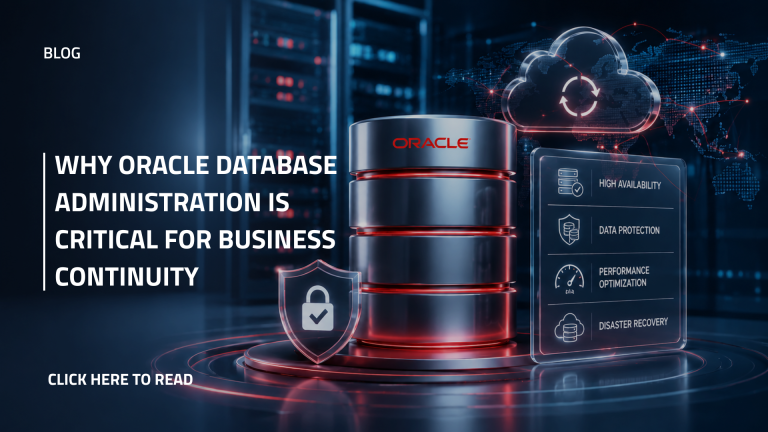
Enterprise databases are increasingly targeted by cyber threats, and the impact of a data breach can be severe. Oracle databases store critical business information, including customer records, financial transactions, and operational data that power essential business applications. If an Oracle database is compromised, it can disrupt enterprise systems, business operations, reporting, and customer trust.
The good news is that most Oracle database breaches can be prevented. In many cases, security incidents result from common vulnerabilities such as weak access controls, delayed patching, lack of encryption, and insufficient monitoring rather than advanced cyberattacks. By following Oracle database security best practices, organizations can significantly reduce security risks and strengthen their overall data protection strategy.
Think of your Oracle database as the vault inside a bank. While firewalls and VPNs protect the building, the vault itself must also be secured. If the vault is left unlocked or access is granted too broadly, the outer security measures offer little protection. A strong database security strategy ensures that your most valuable business data remains protected from unauthorized access and cyber threats.
Why Oracle Database Security Deserves Board-Level Attention
Oracle databases power mission-critical systems for manufacturing plants, financial institutions, and healthcare providers, exactly the kinds of environments where downtime and data loss carry the highest price tags. A single misconfigured privilege or an unpatched vulnerability can expose years of transactional history in minutes. That’s why database security can’t sit only with the DBA team. It needs visibility at the leadership level, because the business impact of a breach reaches well beyond IT.
With that context, here are the practices that matter most.
1. Enforce Least-Privilege Access Controls
The single biggest risk factor in most database breaches isn’t an external hacker; it’s over-provisioned access. When users, applications, or service accounts have more privileges than their job requires, one compromised credential can expose the entire database.
- Apply the principle of least privilege: grant only the access a role genuinely needs, nothing more.
- Use role-based access control (RBAC) instead of assigning permissions to individual users.
- Review privileged accounts (DBA, SYSDBA, SYSOPER) quarterly and revoke access the moment a role changes or an employee exits.
- Separate duties so no single account can both make and approve a critical change.
A quick internal privilege audit often turns up dormant accounts and excessive grants that nobody remembers creating. That single exercise closes more risk than most security tools combined.
2. Turn On Multi-Factor Authentication Everywhere It Counts
Passwords alone are no longer a credible line of defense. Credential theft, phishing, and password reuse make single-factor authentication one of the easiest paths into a database environment.
- Require MFA for all DBA and administrative accounts, not just end users.
- Extend MFA to remote access tools and VPNs that connect to the database tier.
- Pair MFA with strong password policies: minimum complexity, regular rotation, and no shared service-account credentials.
This is a low-cost, high-impact control. It won’t stop every attack, but it removes the easiest ones from the table.
3. Encrypt Data at Rest and in Transit
Encryption is your last line of defense. If every other control fails and an attacker gains access to the raw data, encryption determines whether the data is usable or just noise.
- Use Oracle’s Transparent Data Encryption (TDE) to encrypt tablespaces and sensitive columns at rest.
- Encrypt data in transit between the application layer and the database using TLS.
- Manage encryption keys separately from the database itself, ideally through a dedicated key management service, so a database compromise doesn’t automatically hand over the keys too.
Encryption alone won’t stop a breach, but it dramatically reduces what an attacker can actually do with stolen data.
4. Keep Patching Disciplined and On Schedule
Oracle releases quarterly Critical Patch Updates (CPUs) for a reason: new vulnerabilities surface constantly, and attackers actively scan for organizations running unpatched versions. Delayed patching is one of the most common, and most avoidable, causes of database compromise.
- Apply Oracle’s quarterly CPUs on a fixed schedule rather than an ad hoc one.
- Maintain a test environment to validate patches before rolling them into production, so security updates don’t stall out of fear of breaking something.
- Track end-of-support dates for your Oracle versions. Running unsupported software means running without a safety net.
If patch management feels like it’s always playing catch-up internally, that’s usually a sign the process needs a dedicated owner, whether that’s an internal role or a managed services partner.
5. Monitor and Audit Database Activity Continuously
You can’t respond to a threat you can’t see. Continuous monitoring is what turns a potential multi-week breach into a same-day catch.
- Enable Oracle’s native auditing features to log privileged actions, schema changes, and unusual query patterns.
- Set up real-time alerts for suspicious behavior: logins at odd hours, bulk data exports, or repeated failed authentication attempts.
- Retain audit logs long enough to support forensic investigation and regulatory reporting requirements.
Remember the numbers from earlier: it currently takes organizations well over 180 days on average to even detect a breach. Strong monitoring is what compresses that timeline from months to hours.
6. Segment the Network Around Your Database Tier
Your database shouldn’t be reachable from anywhere an application server can reach. Network segmentation limits how far an attacker can move once they’re inside your environment.
- Place database servers in a dedicated, restricted network segment, isolated from general application and user traffic.
- Use firewalls and access control lists to limit which systems can even attempt a connection to the database.
- Disable unused network services and ports on the database host to shrink the attack surface.
This is the digital equivalent of internal doors and checkpoints inside a building, so a breach in one area doesn’t automatically grant access to everything else.
7. Mask and Redact Sensitive Data in Non-Production Environments
Development and test environments are frequently the weakest link, because they often contain full copies of production data with far fewer controls around them.
- Use Oracle Data Masking and Subsetting to replace sensitive fields with realistic but fictional data in non-production systems.
- Apply Oracle Data Redaction to limit what appears in query results for users who don’t need to see full sensitive fields.
- Treat test and staging environments with the same access discipline as production, not as an afterthought.
8. Build (and Actually Test) Your Backup and Recovery Strategy
Ransomware and insider threats make one thing clear: prevention alone isn’t enough. You need a reliable way to recover if something does go wrong.
- Maintain automated, encrypted backups using Oracle Recovery Manager (RMAN).
- Store backups in a separate, isolated location so a ransomware attack on production can’t also encrypt your backups.
- Run recovery drills on a regular schedule. A backup you’ve never tested restoring is a backup you can’t fully trust.
9. Run Regular Security Assessments and Compliance Checks
Security isn’t a one-time project. Regulations evolve, configurations drift, and new vulnerabilities emerge constantly.
- Schedule periodic vulnerability assessments and configuration reviews against Oracle’s own security benchmarks.
- Map your controls to the compliance frameworks that apply to your industry, whether that’s GDPR, HIPAA, or sector-specific standards.
- Document findings and remediation timelines so security reviews translate into actual fixes, not just a report that sits in a folder.
Putting It All Together
No single control on this list is a silver bullet. The organizations that actually stay secure combine them: tight access controls, encryption, disciplined patching, continuous monitoring, network segmentation, and tested recovery plans, working together as layers. Each layer catches what the one before it might miss.
The harder part for most enterprises isn’t knowing what to do. It’s finding the time, expertise, and dedicated ownership to do it consistently, especially when Oracle environments are running mission-critical SAP or ERP workloads around the clock.
How EDCS Helps Enterprises Secure Their Oracle Databases
This is exactly where Expora Database Consulting Services Pvt. Ltd. fits in. As a certified Oracle Partner with over a decade of experience managing database and infrastructure environments for organizations across manufacturing, automotive, chemicals, and other data-intensive industries, EDCS brings dedicated Oracle expertise that most internal IT teams don’t have the bandwidth to build on their own.
EDCS‘s Database & Infrastructure practice covers the full security lifecycle:
- Managed Oracle DBA services that keep patching, monitoring, and access reviews on a consistent schedule instead of an ad hoc one.
- High-availability and disaster recovery design, including proven experience implementing DR for Oracle RAC and Exadata environments running mission-critical SAP systems.
- Security-focused database audits that identify privilege sprawl, missing encryption, and configuration drift before they become incidents.
- ISO 9001:2015-certified processes, so security and operational work follows a documented, repeatable standard rather than tribal knowledge.
Whether you need a one-time security assessment or an ongoing managed DBA partnership, EDCS designs the engagement around your environment, not a generic checklist.
Ready to Strengthen Your Oracle Database Security?
Enterprise databases are too critical to secure reactively. If it’s been a while since your last access review, patch audit, or DR test, now is the right time to close the gap, before an attacker finds it first.
Talk to EDCS’s Oracle database experts today and get a clear, practical roadmap for protecting your enterprise data.