Your AI Is Smart. But Can It Reach Your Enterprise Systems?
Artificial intelligence has quickly become part of the modern enterprise. Organizations are using AI assistants and agents to summarize documents, generate content, analyze information, answer questions, and support employees across different business functions.
But there is an important limitation.
An AI assistant may be capable of understanding complex questions, yet it may not have access to the systems where critical business information actually exists. For example, an employee may ask an AI assistant about open purchase orders in SAP, overdue invoices, inventory levels, IT incidents, or customer records. If the AI cannot securely connect to those enterprise systems, its ability to provide useful, business-specific answers is limited.
This is where the Model Context Protocol (MCP) becomes important.
MCP provides a standardized way for AI applications to connect with external tools, data sources, and business workflows. For enterprise IT leaders, it offers a practical approach to making AI more useful while maintaining appropriate security, governance, and control.
What Is Model Context Protocol (MCP)?
The Model Context Protocol is an open standard designed to help AI applications connect with external tools, data sources, and workflows.
The simplest way to understand MCP is to think of it as a common connection layer between AI and enterprise systems.
A useful analogy is USB-C. Before USB-C became common, different devices often required different cables and adapters. A standard connection simplified the process by allowing compatible devices to communicate through a common interface.
MCP applies a similar idea to AI integrations.
Instead of building a completely different integration for every AI application and every enterprise system, organizations can use MCP as a standardized way for AI applications to discover and interact with available capabilities.
In simple terms, MCP provides a common language that allows AI systems to interact with enterprise tools, data, and workflows in a structured and controlled way.
Why Should Enterprise IT Leaders Care About MCP?
As organizations experiment with AI, integration complexity can quickly become a challenge.
Imagine an organization has several AI applications and multiple business systems, including ERP platforms, databases, IT service management tools, document repositories, and custom applications.
Without a common integration approach, each AI application may require its own connection to each system. These integrations can have separate authentication mechanisms, business logic, maintenance requirements, and security controls.
This creates what is often described as an N-times-M integration problem.
As the number of AI applications and enterprise systems increases, the number of possible integrations can grow rapidly.
MCP provides a more reusable approach.
Instead of creating separate custom connections for every AI application, an organization can expose approved enterprise capabilities through MCP servers. Compatible AI applications can then interact with those capabilities through the standardized protocol.
This can provide several advantages:
- Faster AI adoption: New AI use cases can be developed without creating every integration from scratch.
- Lower maintenance effort: Reusable connectors can reduce the need for multiple one-off integrations.
- Greater flexibility: Organizations can introduce or change AI applications without necessarily rebuilding their entire integration layer.
- Better control: Enterprise teams can establish consistent security, access, logging, and governance practices around AI connections.
How Does MCP Work?
MCP can be understood through three primary components: the host, client, and server.
1. The Host
The host is the AI application that a user interacts with.
This could be an AI assistant, copilot, or agent-based application.
The host receives the user’s request and determines when it needs additional information or capabilities from an external system.
2. The Client
The client operates within the host application and manages communication with MCP servers.
It acts as the connection mechanism between the AI application and the external capabilities made available through MCP.
3. The Server
The MCP server sits in front of an external tool, system, or data source.
It provides the AI application with information about what capabilities are available and handles approved requests.
An MCP server can expose different types of capabilities, including:
- Tools: Actions an AI application can perform, such as creating a service ticket or updating a business record.
- Resources: Information the AI can access, such as documents, reports, database records, or other enterprise information.
- Prompts: Reusable templates that can help guide AI applications through specific tasks.
Consider a finance-related example.
A finance manager asks an AI assistant:
“Which vendor invoices are overdue by more than 30 days?”
Instead of requiring the AI to have direct database credentials, the AI can use an appropriate MCP connection to request the required information from the enterprise system. The MCP server provides access through a defined and controlled interface, and the AI can then present the information in a useful format.
Where Does MCP Fit Into Enterprise Architecture?
MCP does not replace existing APIs, middleware, databases, or enterprise integration platforms.
Instead, it can sit as an AI-oriented layer above existing enterprise technology.
Organizations already use APIs and integration platforms to connect business applications. MCP can provide AI applications with a standardized way to understand and use those capabilities.
A simple way to visualize the relationship is:
Enterprise systems → APIs and integration layers → MCP → AI applications
Existing enterprise architecture remains important. MCP adds a standardized mechanism that makes those enterprise capabilities more accessible to AI applications.
Potential enterprise connection points include:
ERP and Core Business Systems
ERP platforms such as SAP contain important information related to finance, procurement, supply chain, manufacturing, and other business processes.
MCP can help AI applications access approved business information and capabilities through controlled interfaces.
Databases
Organizations rely on databases such as Oracle and other data platforms to store operational and analytical information.
MCP can provide AI applications with controlled access to relevant data without requiring every AI application to build a separate database integration.
IT Service Management and Collaboration Tools
AI applications can connect to approved ticketing, documentation, messaging, and service-management systems.
This can support use cases such as incident analysis, knowledge retrieval, and service-desk automation.
Document Repositories
Enterprise documents often contain policies, contracts, procedures, manuals, and internal knowledge.
Connecting AI to approved repositories can help employees find relevant information using natural-language questions.
Custom Applications
Many organizations operate internally developed applications that support specialized business processes.
MCP can provide another mechanism for exposing selected capabilities of these applications to AI.
Real-World Enterprise Use Cases for MCP
MCP becomes easier to understand when viewed through practical business scenarios.
Supply Chain Visibility
A supply chain planner may need information about inventory levels, supplier delays, open purchase orders, and other operational conditions.
Instead of manually checking several systems, an AI assistant could retrieve approved information from multiple connected sources and present it in one consolidated response.
This can help employees spend less time searching for information and more time making decisions.
IT Service Desk Automation
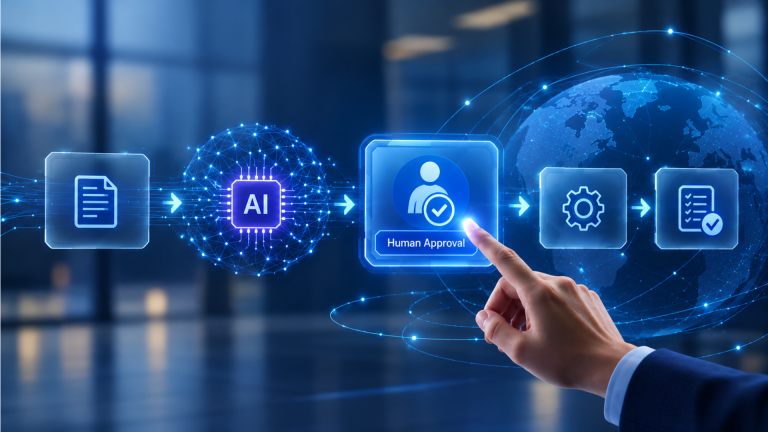
An AI agent could receive an incoming incident, search an approved knowledge base, retrieve information about the affected asset, and prepare a potential resolution.
For high-impact activities, human approval can remain part of the workflow before any production system is changed.
This approach can combine AI-driven efficiency with human oversight.
Finance and Compliance
Finance teams can use AI to retrieve relevant transaction information and compare it against established policies or rules.
The AI can identify potential exceptions and present them for human review.
The objective is not to remove human judgment but to reduce the manual effort involved in finding and analyzing information.
Developer Productivity
Developers can work with AI tools connected to approved repositories, documentation, build pipelines, and development resources.
Instead of relying only on general knowledge, the AI can use relevant context from the organization’s own environment.
This can make AI assistance more useful for troubleshooting, documentation, development questions, and other engineering tasks.
Security and Governance: The Most Important Consideration
Connecting AI to enterprise systems creates significant opportunities, but it also introduces risk.
An MCP server may provide access to sensitive business information or capabilities that can perform real actions. Therefore, organizations should treat MCP connections as important enterprise integration points rather than simple plug-ins.
Excessive Permissions
An AI connection with excessive permissions could potentially access or modify more information than required.
Organizations should follow the principle of least privilege and provide only the permissions necessary for a specific use case.
Authentication and Authorization
Strong identity and authorization controls are essential.
Enterprise implementations should use appropriate modern authentication and authorization mechanisms and avoid insecure practices such as shared credentials or hard-coded access keys.
Prompt Injection
AI applications can potentially encounter malicious instructions within documents, emails, web content, or other data.
These instructions may attempt to influence the AI into performing unintended actions.
Organizations should therefore consider input validation, output controls, testing, and human approval mechanisms when designing AI workflows.
Untrusted MCP Servers
Organizations should carefully evaluate MCP servers before allowing them to connect to sensitive enterprise environments.
An unverified server should be treated similarly to other untrusted software or integrations.
A central registry of approved MCP servers can help organizations maintain better visibility and control.
Auditability
When an AI application retrieves sensitive information or performs an action, organizations need to understand what happened.
Audit logs should help answer questions such as:
- Who initiated the request?
- What information was accessed?
- What action was performed?
- Which system was involved?
- Was human approval required?
- What was the result?
Strong auditability is important for both security and compliance.
A Practical MCP Governance Checklist
Organizations planning an MCP rollout can begin with a structured governance framework:
- Inventory MCP servers: Maintain a central register of servers, owners, connected systems, and data access.
- Apply least privilege: Give every connection only the permissions it needs.
- Strengthen identity controls: Connect AI actions to appropriate user identities and role-based permissions.
- Use human approval: Require approval for high-impact activities such as payments, deletions, and production changes.
- Maintain audit logs: Record relevant requests, responses, and actions.
- Test adversarial scenarios: Include prompt-injection and other security scenarios in testing.
- Monitor continuously: Watch for unusual activity, failures, access patterns, and performance issues.
- Consider compliance: Map AI data flows to privacy, residency, and industry-specific obligations.
Governance does not have to become a barrier to innovation. When the right controls are established early, teams can experiment and scale AI with greater confidence.
A Practical Roadmap for Getting Started
Organizations do not need to connect every system to MCP immediately.
A phased approach can help reduce risk while demonstrating value.
Phase 1: Assess
Start by identifying two or three high-value, relatively low-risk use cases.
Map the systems, data, users, and workflows involved. At this stage, review the existing integration and security environment.
Phase 2: Pilot
Build a small number of MCP servers, preferably beginning with read-only access.
Test the solution with a limited group of users and evaluate factors such as accuracy, response speed, usefulness, and user experience.
Phase 3: Govern
Before expanding access, establish policies, ownership models, server registries, logging requirements, security controls, and approval workflows.
Phase 4: Scale
Once the organization has gained confidence, gradually introduce additional systems, teams, and controlled write actions.
Starting with read-only use cases can be an effective way to demonstrate value while building trust in the technology.
Common MCP Implementation Mistakes to Avoid
Organizations should also be aware of several common mistakes.
Treating MCP as a simple plug-in: MCP can influence enterprise architecture and security, so implementation requires proper planning.
Ignoring data quality: AI connected to inaccurate or inconsistent enterprise data may produce inaccurate answers faster.
Over-permissioning: Giving broad access during a pilot can create security problems that become difficult to remove later.
Ignoring ownership: Every MCP server should have a clearly identified owner responsible for its operation, security, and maintenance.
Forgetting change management: Employees need to understand what the AI can do, what information it can access, and when human judgment is still required.
How EDCS Can Support Your MCP Journey
Connecting AI to enterprise systems requires more than adopting a protocol. Organizations also need expertise across AI, enterprise applications, databases, integration, security, and business processes.
Expora Database Consulting Services Pvt. Ltd. brings extensive experience in enterprise technology and works across SAP, Oracle, and AI engineering environments.
Our approach can support organizations at different stages of their MCP journey.
MCP Readiness Assessment
We can review existing systems, data, security controls, and business use cases to identify where MCP can deliver meaningful value.
Architecture and Design
We can help organizations determine how MCP servers can fit alongside SAP, Oracle, APIs, databases, and other enterprise platforms while maintaining appropriate access controls.
MCP Server Development
Organizations can build controlled connectors that expose selected tools and data to AI applications in a structured and documented manner.
Security and Governance
A successful AI integration requires appropriate access controls, audit logging, approval checkpoints, monitoring, and server-vetting processes.
Data and Database Foundation
AI is only as useful as the data behind it. Strong data quality, availability, security, and database management provide an important foundation for reliable enterprise AI.
Run and Optimize
Enterprise AI integrations must evolve as systems, processes, and business requirements change. Continuous monitoring, maintenance, and optimization can help keep these integrations reliable.
Key Takeaways
The Model Context Protocol represents an important development in enterprise AI integration.
It provides a standardized approach for AI applications to connect with external tools, data, and workflows. Instead of creating numerous one-off integrations, organizations can establish reusable connections that can support multiple AI applications.
However, technology alone does not guarantee success.
When AI connects to business-critical systems, security, governance, data quality, identity management, monitoring, and human oversight are essential.
A phased implementation can help organizations begin with lower-risk, read-only use cases, demonstrate value, establish governance, and gradually expand toward more advanced automation.
For enterprise IT leaders, the opportunity is not simply to connect AI to more systems. The goal is to build a secure, governed, scalable foundation that lets AI work with real business context.
Ready to Connect AI to Your Enterprise?
AI can deliver significantly more value when it can securely access the systems and information that power everyday business operations.
MCP provides a standardized way to create these connections. A well-designed architecture, supported by strong security and governance, helps organizations use that capability responsibly.
For enterprises exploring MCP, the first step is to identify where AI can solve a meaningful business problem and then determine how it can access the required systems safely.
Talk to the EDCS team to assess your MCP readiness and identify potential enterprise AI use cases.
Clarify MCP’s architectural boundaries. Make the EDCS value proposition specific