Oracle RAC keeps your database running when a server fails. Oracle Data Guard keeps your data safe when an entire site fails. RAC protects you inside the data centre. Data Guard protects you beyond it. Most enterprises that run critical workloads need both.
If you manage databases for a bank, a manufacturer, a retailer or a hospital, you already know the cost of downtime. Orders stall. Customers leave. Teams scramble. Regulators ask questions.
Oracle gives you two powerful tools to prevent that outcome: Real Application Clusters (RAC) and Data Guard. People often compare them as if one must win. In reality, they solve different problems. Let’s break them down in plain language.
Why RAC and Data Guard Get Confused
Both technologies fall under “high availability.” Both appear in Oracle’s Maximum Availability Architecture (MAA). Both keep Oracle databases alive when something breaks.
The difference lies in what breaks.
- A server crashes, a node loses power, or a patch needs a restart: RAC handles it.
- A data centre floods, a regional outage hits, or ransomware corrupts the primary site: Data Guard handles it.
Think of RAC as an aircraft with several engines. Lose an engine, and the plane keeps flying. Data Guard is a second aircraft waiting on another runway, fully fuelled, with the same passengers’ details already on board. Lose the airport, and the journey continues from elsewhere.
What Is Oracle RAC?
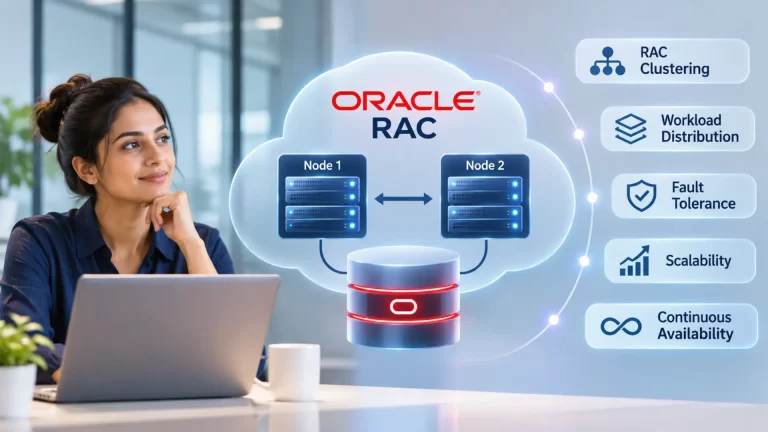
Oracle Real Application Clusters lets multiple servers (nodes) run a single Oracle database at the same time. All nodes access the same shared storage. Users connect to the cluster, not to one machine.
What that means in practice:
- Node failure tolerance. If one node goes down, sessions move to surviving nodes. Users may see a brief pause, not an outage.
- Horizontal scalability. Need more capacity? Add a node instead of replacing hardware.
- Rolling maintenance. Patch one node at a time while the others serve traffic.
- Load distribution. Workloads spread across nodes, which improves response times during peak hours.
RAC works best for organisations that cannot afford even short interruptions from server-level failures and need room to grow. If you want a deeper look at how it works, explore our guide on Oracle RAC architecture and enterprise database high availability.
The limit of RAC
RAC runs in one location with one copy of the data on shared storage. If the storage array fails, or the whole site goes dark, every node goes with it. RAC alone is not a disaster recovery plan.
What Is Oracle Data Guard?
Oracle Data Guard creates and maintains one or more standby databases. The primary database sends its redo data (the record of every change) to the standby. The standby applies those changes continuously and stays in sync.
When the primary fails, you switch roles. The standby becomes the new primary, and applications reconnect.
What that means in practice:
- Disaster recovery. The standby sits in a separate data centre, city or cloud region.
- Data protection. Data Guard can detect and block certain types of corruption before they reach the standby copy.
- Flexible protection modes. You choose between maximum protection, maximum availability and maximum performance, depending on how much data loss you can tolerate.
- Planned switchovers. Move operations to the standby for maintenance or testing, then switch back.
- Active Data Guard. With the Active Data Guard option, the standby can serve read-only queries and reporting while it stays in sync, so the investment does real work every day.
Oracle’s own documentation covers the technology in detail in the Data Guard Concepts and Administration guide.
The limit of Data Guard
A standby database does not scale your workload the way RAC does. During a failover, applications need to reconnect, and the switch takes more time than a RAC node eviction. Data Guard answers the question “Can we recover?” RAC answers the question “Can we keep going without anyone noticing?”
Oracle RAC vs Data Guard: Side-by-Side Comparison
| Factor | Oracle RAC | Oracle Data Guard |
|---|---|---|
| Primary purpose | High availability and scalability | Disaster recovery and data protection |
| Failure it protects against | Server or instance failure | Site failure, storage failure, data corruption, human error |
| Number of database copies | One database, many instances | Primary plus one or more standby databases |
| Storage | Shared storage | Separate storage at each site |
| Typical location | Single data centre | Two or more geographically separate sites |
| Failover speed | Seconds, often invisible to users | Minutes, depending on configuration and automation |
| Data loss risk | None for node failure | Near zero to zero, based on protection mode |
| Scalability benefit | Yes, add nodes | Limited, unless Active Data Guard offloads reads |
| Best for | Always-on transaction systems | Business continuity and compliance needs |
Two Terms Every Decision Maker Should Know
Before choosing, translate your business needs into two numbers.
RTO (Recovery Time Objective): How long can the business stay offline? Ten seconds? Ten minutes? Four hours?
RPO (Recovery Point Objective): How much recent data can the business afford to lose? None? One minute? One day?
A payment gateway might demand an RTO of seconds and an RPO of zero. An internal reporting database may tolerate an RTO of several hours. Your answers decide the architecture, and they decide the budget too. Oracle’s MAA framework follows the same logic, matching technology tiers to recovery objectives.
A Real-World Scenario
Picture a mid-sized manufacturer in Bengaluru running SAP on an Oracle database. A power fault takes out one of its two database servers on a Monday morning.
With RAC in place, the surviving node picks up the load. Production planners keep working, and most users never notice.
Now imagine a different event. A fire suppression failure damages the entire server room. RAC cannot help, because every node sits in the same room. With Data Guard, a standby database in another city takes over. The business resumes operations within minutes, with little or no data lost.
The manufacturer that runs only RAC survives the first event and loses days in the second. The one that runs only Data Guard survives the second event but takes a short outage in the first. The one that runs both survives either.
When Should You Choose Each Option?
Choose Oracle RAC when:
- Downtime from server failures is unacceptable
- Your workload grows and needs scalable capacity
- You need rolling patches without a service window
- Your business runs from one primary location
Choose Oracle Data Guard when:
- Regulations or audits require a disaster recovery site
- You must protect against site-wide outages, corruption, or ransomware
- You want a standby that can also serve reporting workloads
- Budget rules out a full cluster, but the business still needs strong protection
Choose both when:
- The database runs revenue-critical or compliance-critical systems
- Your RTO is measured in seconds, and your RPO is close to zero
- You want the gold standard of Oracle availability
Combining RAC at the primary site with Data Guard at a remote site is the core of Oracle’s Maximum Availability Architecture. Each layer covers the gaps in the other.
Five Mistakes Teams Make
- Treating RAC as disaster recovery. A cluster in one room is still one room.
- Never testing the standby. An untested failover plan is a hope, not a plan. Run switchover drills at least twice a year.
- Ignoring network capacity. Data Guard relies on timely redo transport. A weak link between sites creates lag and raises your RPO.
- Skipping application readiness. The database may fail over cleanly while applications still point to the old server. Connection strings, services, and failover settings need attention.
- Forgetting backups. Neither RAC nor Data Guard replaces a solid backup and recovery strategy with Oracle RMAN. Pair them with tested backups.
A Quick Planning Checklist
Before you commit to RAC, Data Guard, or both, answer these questions:
- What is the cost of one hour of downtime for our business?
- What are our RTO and RPO for each critical application?
- Do compliance rules require an offsite recovery copy?
- Does our team have the skills to manage a cluster and a standby environment?
- Are our licences, hardware, and network ready for the design?
- When did we last test a real failover?
If several answers feel uncertain, an assessment by experienced database architects will save time and money.
How EDCS Can Help
Expora Database Consulting Services (EDCS) has supported enterprises from Bengaluru since 2006. Our team brings deep expertise in Oracle technologies, including maximum availability architecture, disaster recovery implementation, and maintenance using Real Application Clusters, Automatic Storage Management, and Data Guard.
Here is how we support your high availability and disaster recovery journey through our Oracle database consulting services:
- Architecture assessment. We review your current setup, map your RTO and RPO targets, and recommend the right mix of RAC, Data Guard, or both.
- Implementation. Our certified experts design, build, and configure RAC clusters and standby environments with proven best practices.
- Migration and upgrades. We move your databases to new platforms or versions with minimal downtime and managed risk. Read more about low-risk Oracle database migration planning.
- Performance tuning. We keep your cluster balanced and your standby in step. Our guide to Oracle database performance tuning shares practical tips.
- Backup, recovery and DR drills. We set up tested backup strategies and run failover exercises, so your team knows exactly what to do on the worst day.
- Ongoing support. Our database administrators monitor, patch and optimise your environment, so your internal team can focus on growth.
EDCS also delivers SAP services, Oracle EBS services and IT staffing, so your database strategy connects with the applications that depend on it. Our work follows a quality management system built on continuous improvement and customer satisfaction.
The Bottom Line
Oracle RAC and Data Guard are partners, not rivals. RAC keeps applications running through server failures and supports growth. Data Guard protects your data through site failures, corruption, and disasters. Pick based on your recovery objectives, your risk appetite, and your budget. For critical systems, combine both.
Your database is the heartbeat of your business. Protect it with a plan built for the failures you hope never happen.
Ready to Build a Resilient Oracle Environment?
Talk to the Oracle experts at EDCS. We will assess your current setup, identify gaps, and design a high availability and disaster recovery strategy that fits your business and budget.
Contact EDCS today to book a free consultation, or visit www.edcs.co.in to explore our services. Oracle RAC keeps your database running when a server fails. Oracle Data Guard keeps your data safe when an entire site fails. RAC protects you inside the data centre. Data Guard protects you beyond it. Most enterprises that run critical workloads need both.
If you manage databases for a bank, a manufacturer, a retailer or a hospital, you already know the cost of downtime. Orders stall. Customers leave. Teams scramble. Regulators ask questions.
Oracle gives you two powerful tools to prevent that outcome: Real Application Clusters (RAC) and Data Guard. They often get compared as if one must win. In reality, they solve different problems. Let’s break them down in plain language.
Why RAC and Data Guard Get Confused
Both technologies fall under “high availability.” Both appear in Oracle’s Maximum Availability Architecture (MAA). Both keep Oracle databases alive when something breaks.
The difference lies in what breaks.
- A server crashes, a node loses power, or a patch needs a restart: RAC handles it.
- A data centre floods, a regional outage hits, or ransomware corrupts the primary site: Data Guard handles it.
Think of RAC as having several engines on one aircraft. Lose an engine, and the plane keeps flying. Data Guard is a second aircraft waiting on another runway, fully fuelled, with the same passengers’ details already on board. Lose the airport, and the journey continues from elsewhere.
What Is Oracle RAC?
Oracle Real Application Clusters lets multiple servers (nodes) run a single Oracle database at the same time. All nodes access the same shared storage. Users connect to the cluster, not to one machine.
What that means in practice:
- Node failure tolerance. If one node goes down, sessions move to surviving nodes. Users may see a brief pause, not an outage.
- Horizontal scalability. Need more capacity? Add a node instead of replacing hardware.
- Rolling maintenance. Patch one node at a time while the others serve traffic.
- Load distribution. Workloads spread across nodes, which improves response times during peak hours.
RAC works best for organisations that cannot afford even short interruptions from server-level failures and need room to grow. If you want a deeper look at how it works, explore our guide on Oracle RAC architecture and enterprise database high availability.
The limit of RAC
RAC runs in one location with one copy of the data on shared storage. If the storage array fails, or the whole site goes dark, every node goes with it. RAC alone is not a disaster recovery plan.
What Is Oracle Data Guard?
Oracle Data Guard creates and maintains one or more standby databases. The primary database sends its redo data (the record of every change) to the standby. The standby applies those changes continuously and stays in sync.
When the primary fails, you switch roles. The standby becomes the new primary, and applications reconnect.
What that means in practice:
- Disaster recovery. The standby sits in a separate data centre, city or cloud region.
- Data protection. Data Guard can detect and block certain types of corruption before they reach the standby copy.
- Flexible protection modes. You choose between maximum protection, maximum availability and maximum performance, depending on how much data loss you can tolerate.
- Planned switchovers. Move operations to the standby for maintenance or testing, then switch back.
- Active Data Guard. With the Active Data Guard option, the standby can serve read-only queries and reporting while it stays in sync, so the investment does real work every day.
Oracle’s own documentation covers the technology in detail in the Data Guard Concepts and Administration guide.
The limit of Data Guard
A standby database does not scale your workload the way RAC does. During a failover, applications need to reconnect, and the switch takes more time than a RAC node eviction. Data Guard answers the question “Can we recover?” RAC answers the question “Can we keep going without anyone noticing?”
Oracle RAC vs Data Guard: Side-by-Side Comparison
| Factor | Oracle RAC | Oracle Data Guard |
|---|---|---|
| Primary purpose | High availability and scalability | Disaster recovery and data protection |
| Failure it protects against | Server or instance failure | Site failure, storage failure, data corruption, human error |
| Number of database copies | One database, many instances | Primary plus one or more standby databases |
| Storage | Shared storage | Separate storage at each site |
| Typical location | Single data centre | Two or more geographically separate sites |
| Failover speed | Seconds, often invisible to users | Minutes, depending on configuration and automation |
| Data loss risk | None for node failure | Near zero to zero, based on protection mode |
| Scalability benefit | Yes, add nodes | Limited, unless Active Data Guard offloads reads |
| Best for | Always-on transaction systems | Business continuity and compliance needs |
Two Terms Every Decision Maker Should Know
Before choosing, translate your business needs into two numbers.
RTO (Recovery Time Objective): How long can the business stay offline? Ten seconds? Ten minutes? Four hours?
RPO (Recovery Point Objective): How much recent data can the business afford to lose? None? One minute? One day?
A payment gateway might demand an RTO of seconds and an RPO of zero. An internal reporting database may tolerate an RTO of several hours. Your answers decide the architecture, and they decide the budget too. Oracle’s MAA framework follows the same logic, matching technology tiers to recovery objectives.
A Real-World Scenario
Picture a mid-sized manufacturer in Bengaluru running SAP on an Oracle database. A power fault takes out one of its two database servers on a Monday morning.
With RAC in place, the surviving node picks up the load. Production planners keep working, and most users never notice.
Now imagine a different event. A fire suppression failure damages the entire server room. RAC cannot help, because every node sits in the same room. With Data Guard, a standby database in another city takes over. The business resumes operations within minutes, with little or no data lost.
The manufacturer that runs only RAC survives the first event and loses days in the second. The one that runs only Data Guard survives the second event but takes a short outage in the first. The one that runs both survives either.
When Should You Choose Each Option?
Choose Oracle RAC when:
- Downtime from server failures is unacceptable
- Your workload grows and needs scalable capacity
- You need rolling patches without a service window
- Your business runs from one primary location
Choose Oracle Data Guard when:
- Regulations or audits require a disaster recovery site
- You must protect against site-wide outages, corruption, or ransomware
- You want a standby that can also serve reporting workloads
- Budget rules out a full cluster, but the business still needs strong protection
Choose both when:
- The database runs revenue-critical or compliance-critical systems
- Your RTO is measured in seconds, and your RPO is close to zero
- You want the gold standard of Oracle availability
Combining RAC at the primary site with Data Guard at a remote site is the core of Oracle’s Maximum Availability Architecture. Each layer covers the gaps in the other.
Five Mistakes Teams Make
- Treating RAC as disaster recovery. A cluster in one room is still one room.
- Never testing the standby. An untested failover plan is a hope, not a plan. Run switchover drills at least twice a year.
- Ignoring network capacity. Data Guard relies on timely redo transport. A weak link between sites creates lag and raises your RPO.
- Skipping application readiness. The database may fail over cleanly while applications still point to the old server. Connection strings, services, and failover settings need attention.
- Forgetting backups. Neither RAC nor Data Guard replaces a solid backup and recovery strategy with Oracle RMAN. Pair them with tested backups.
A Quick Planning Checklist
Before you commit to RAC, Data Guard, or both, answer these questions:
- What is the cost of one hour of downtime for our business?
- What are our RTO and RPO for each critical application?
- Do compliance rules require an offsite recovery copy?
- Does our team have the skills to manage a cluster and a standby environment?
- Are our licences, hardware, and network ready for the design?
- When did we last test a real failover?
If several answers feel uncertain, an assessment by experienced database architects will save time and money.
How EDCS Can Help
Expora Database Consulting Services Pvt. Ltd. has supported enterprises from Bengaluru since 2009. Our team brings deep expertise in Oracle technologies, including maximum availability architecture, disaster recovery implementation, and maintenance using Real Application Clusters, Automatic Storage Management, and Data Guard.
Here is how we support your high availability and disaster recovery journey through our Oracle database consulting services:
- Architecture assessment. We review your current setup, map your RTO and RPO targets, and recommend the right mix of RAC, Data Guard, or both.
- Implementation. Our certified experts design, build, and configure RAC clusters and standby environments with proven best practices.
- Migration and upgrades. We move your databases to new platforms or versions with minimal downtime and managed risk. Read more about low-risk Oracle database migration planning.
- Performance tuning. We keep your cluster balanced and your standby in step. Our guide to Oracle database performance tuning shares practical tips.
- Backup, recovery and DR drills. We set up tested backup strategies and run failover exercises, so your team knows exactly what to do on the worst day.
- Ongoing support. Our database administrators monitor, patch and optimise your environment, so your internal team can focus on growth.
EDCS also delivers SAP services, Oracle EBS services and IT staffing, so your database strategy connects with the applications that depend on it. Our work follows a quality management system built on continuous improvement and customer satisfaction.
Building a Resilient Oracle Database Strategy
Oracle RAC and Data Guard are partners, not rivals. RAC keeps applications running through server failures and supports growth. Data Guard protects your data through site failures, corruption, and disasters. Pick based on your recovery objectives, your risk appetite, and your budget. For critical systems, combine both.
Your database is the heartbeat of your business. Protect it with a plan built for the failures you hope never happen.
Ready to Build a Resilient Oracle Environment?
Talk to the Oracle experts at EDCS. We will assess your current setup, identify gaps, and design a high-availability and disaster recovery strategy that fits your business and budget.
Contact EDCS today to book a free consultation, or visit www.edcs.co.in to explore our services.