When Machine Intelligence Meets Enterprise Backbone
Picture a factory floor where a machine flags its own failure three weeks before it happens. Picture a finance team that closes its books in two days instead of ten, because anomalies are caught the moment they appear. Picture a supply chain that reroutes itself around a shipping delay before anyone notices the disruption.
None of these scenarios are science fiction anymore. They are what happens when artificial intelligence gets wired directly into the systems that already run the business, and for most large organizations, the system running the business is SAP.
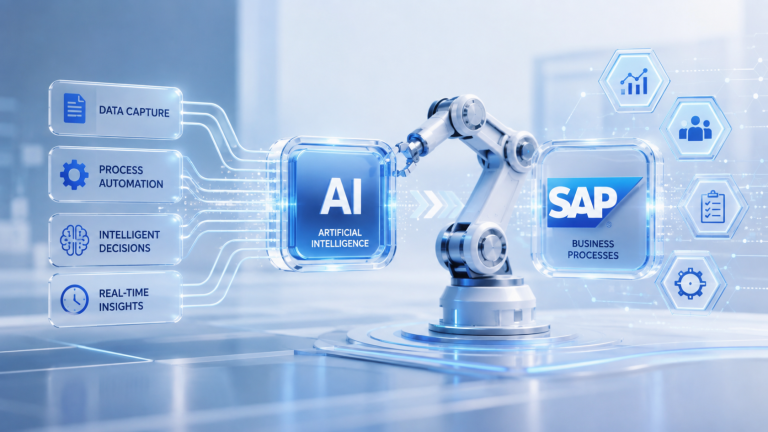
Enterprises have spent decades building their operational backbone on SAP, from finance and procurement to manufacturing and logistics. AI, meanwhile, has spent the last few years proving it can spot patterns humans miss, predict outcomes before they unfold, and automate decisions at a speed no manual process can match. Bring the two together, and you get something far more powerful than either on its own: an intelligent enterprise where data, process, and decision-making work as a single connected system.
Let’s unpack how that combination actually works, why it matters right now, and what it takes to get there.
Why SAP Was Always Built for This Moment
SAP was never just a piece of software. Over the years, it evolved into the operational nervous system for thousands of organizations worldwide, holding financial records, HR data, procurement history, inventory movements, and production schedules in one place. That centralization is exactly what makes it such fertile ground for AI.
Machine learning models are only as good as the data feeding them. Fragmented data spread across a dozen disconnected tools produces fragmented insight. SAP’s structured, standardized, enterprise-wide data model gives AI something rare: a clean, consistent, high-volume source of truth to learn from.
With platforms like SAP S/4HANA, SAP Business Technology Platform, and embedded machine learning capabilities such as SAP AI Core and SAP AI Launchpad, intelligence is no longer bolted on as an afterthought. It sits inside the transactional core, watching every order, invoice, and shipment as it happens, and acting on it in real time.
What AI Actually Adds to the SAP Landscape
It helps to break the value down into concrete capabilities rather than buzzwords.
Predictive Insight Instead of Historical Reporting
Traditional ERP reporting tells leaders what already happened last quarter. AI embedded inside SAP tells them what is likely to happen next quarter. Demand forecasting models trained on years of sales data can anticipate seasonal spikes, predict stockouts, and flag slow-moving inventory long before a warehouse manager would notice on a spreadsheet.
Predictive Maintenance on the Shop Floor
Manufacturers running SAP alongside IoT sensors can feed real-time equipment data into machine learning models that detect the earliest signs of mechanical wear. A pump vibrating slightly outside normal range, a motor running a few degrees hotter than usual- these tiny signals become early warnings instead of expensive breakdowns. The result is fewer unplanned outages, longer asset life, and safer plants.
Intelligent Process Automation
Every large enterprise has processes bogged down by manual, repetitive work: invoice matching, purchase order approvals, employee onboarding paperwork, expense validation. AI-powered automation inside SAP workflows can read documents, extract data, flag exceptions, and route approvals automatically, freeing skilled employees to focus on judgment calls rather than data entry.
Smarter Financial Planning
Finance teams using SAP with embedded AI can move from static budgets to rolling, continuously updated forecasts. Anomaly detection flags unusual transactions in real time, reducing fraud risk and tightening compliance, while cash flow prediction models help treasury teams plan with far more confidence than a quarterly review ever allowed.
Conversational and Generative Interfaces
Generative AI layered on top of SAP, through tools like SAP Joule, lets employees simply ask questions in plain language rather than navigating complex transaction codes. “Show me last month’s top three underperforming SKUs” becomes a spoken or typed request instead of a multi-step reporting exercise. Access to enterprise intelligence stops being a privilege reserved for analysts and becomes something every employee can use.
Building Blocks of the Intelligent Enterprise
An intelligent enterprise is not a single product you buy off a shelf. It is an architecture built from several layers working together.
Clean, unified data forms the base layer. AI models trained on messy, duplicated, or siloed data produce unreliable results, so data governance and master data management inside SAP become non-negotiable foundations rather than back-office chores.
A modern cloud-ready core comes next. SAP S/4HANA Cloud provides the real-time processing speed that AI workloads demand, replacing legacy batch-processing systems that simply cannot keep pace with live predictive models.
Embedded intelligence sits on top of that core, where machine learning models, natural language processing, and generative AI tools plug directly into business processes rather than existing as separate standalone applications that employees have to switch between.
Integration across the technology stack ties everything together, connecting SAP with IoT devices, third-party analytics tools, and cloud platforms so intelligence flows freely between systems instead of getting trapped in silos.
A culture ready for change completes the picture. Technology alone never transforms an organization. Employees need training, trust in AI-driven recommendations, and clear governance around how automated decisions get made and reviewed.
Industry Examples Bringing It to Life
Manufacturing companies use AI within SAP to balance production schedules against real-time demand signals, cutting excess inventory while avoiding stockouts. Pharmaceutical companies apply AI to track batch quality and regulatory compliance automatically, reducing the manual audit burden that used to consume weeks of staff time. Retailers combine SAP’s transactional backbone with AI-driven personalization engines to predict what customers want before those customers search for it themselves. Logistics providers use predictive routing models fed by live SAP transportation data to reroute shipments around delays, saving fuel costs and protecting delivery commitments.
Across every one of these industries, the pattern repeats: SAP provides the structured operational data, AI turns that data into foresight, and the enterprise becomes measurably faster and smarter at responding to change.
The Real Barriers Standing in the Way
None of this happens automatically just because a company owns an SAP license and has heard of ChatGPT. Several genuine obstacles slow organizations down.
Legacy systems still running outdated SAP versions often lack the real-time processing power AI workloads require, making an upgrade to S/4HANA a practical prerequisite rather than an optional nice-to-have. Data quality issues, duplicate vendor records, inconsistent naming conventions, and missing fields quietly undermine even the most sophisticated machine learning model. Skill gaps present another challenge, since building and maintaining AI-driven SAP solutions demands a rare combination of ERP expertise and data science fluency that few in-house teams have fully in place. Change management rounds out the list, because employees accustomed to years of familiar workflows need guidance, training, and confidence before they trust an algorithm’s recommendation over their own gut instinct.
None of these barriers are permanent. They are simply reasons why the right implementation partner matters as much as the right technology.
How EDCS Helps Enterprises Get There
Turning SAP into a genuinely intelligent platform takes more than switching on a feature. It takes a partner who understands both the deep mechanics of SAP and the practical realities of applying AI inside a live production environment, without disrupting the operations a business depends on every single day.
Expora Database Consulting Services Pvt. Ltd. is a Bengaluru-based, ISO 9001:2015 certified SAP Silver Partner with more than a decade of enterprise consulting experience, and that track record spans manufacturing, pharma, logistics, retail, FMCG, and automotive sectors. The team has guided organizations through complete SAP transformations, from requirement analysis and system design through deployment, customization, and long-term optimization.
For companies exploring AI within their SAP landscape, EDCS brings capability across several fronts:
SAP S/4HANA migration and modernization, ensuring the technical foundation is ready to support real-time, AI-driven processing before any advanced use case gets built on top of it.
Embedded AI implementation, from predictive maintenance models on the shop floor to intelligent automation inside finance and procurement workflows, tailored to the specific processes a business actually runs rather than generic templates.
Supply chain and planning optimization, drawing on more than a decade of hands-on experience with SAP APO and SAP Integrated Business Planning to help clients improve forecast accuracy, inventory visibility, and demand response.
Data quality and governance work, the unglamorous but essential groundwork that determines whether an AI model produces trustworthy insight or noisy guesswork.
SAP SuccessFactors and HR transformation, helping organizations build the clean, connected employee data foundation that AI-powered talent matching and workforce planning ultimately depend on.
End-to-end support and continuous optimization, because an intelligent enterprise is never a one-time project. It is a system that keeps learning, keeps improving, and needs a partner who stays engaged long after go-live.
The Road Ahead
The organizations that will lead their industries over the next decade are not simply the ones that adopt AI, and they are not simply the ones that run SAP. They are the ones that fuse the two into a single, connected operating model where data flows freely, decisions get made faster, and every employee, from the shop floor to the boardroom, has intelligent guidance built directly into their daily work.
That future is not distant. The technology exists today, the platforms are mature, and the path is well understood by those who have walked it before. What remains is the willingness to invest, the discipline to fix the data foundation first, and a partner experienced enough to guide the journey without costly missteps.
AI plus SAP is not a passing trend bolted onto an old system. It is the new foundation of enterprise operations, and the companies building on it today are the ones setting the pace for everyone else tomorrow.
Ready to explore what an AI-powered SAP landscape could look like for your business? Connect with the team at EDCS and take the first step toward a truly intelligent enterprise.