Vision AI uses cameras and trained machine learning models to inspect every product on a line, in real time. It spots scratches, cracks, missing parts, wrong labels, and misaligned components, then decides in milliseconds whether to pass, flag, or reject the item.
It does not get tired, distracted, or inconsistent. It also records every decision, which turns quality control from a gut-feel exercise into a data-driven one.
The rest of the blog explains how it works step by step, where it delivers the most value, and how to bring it into your plant without disrupting production.
Why Manual Inspection Is Hitting Its Limit
Picture a packaging line running at full speed. An inspector stands at the end, scanning hundreds of items an hour for tiny flaws. By the third hour, attention drifts. By the sixth, small defects start slipping through.
Human inspectors are skilled, but human vision has natural limits:
- Fatigue: Accuracy drops over long shifts.
- Subjectivity: Two inspectors can judge the same part differently.
- Speed: Modern lines move faster than the eye can follow.
- No record: Manual checks rarely leave behind searchable data.
A single defective part that reaches a customer can mean returns, rework, warranty claims, and damaged trust. Vision AI closes the gap by giving every product the same careful look, every time.
What Is Vision AI, in Plain Words?
Think of Vision AI as a quality inspector who has studied thousands of examples of good and bad products, never forgets what it learned, and works around the clock.
Technically, it combines three things:
- Cameras and lighting that capture clear images of each product.
- Computer vision models (usually deep learning) that learn what “good” and “defective” look like.
- Software and integrations that turn the model’s decision into action on the line.
Traditional machine vision relied on fixed rules, such as “reject if this edge is longer than 2 mm.” Rules work for simple, predictable parts. They struggle with natural variation, like wood grain, fabric texture, or a slightly different paint shade. Vision AI learns patterns from examples, so it handles variation far better.
How Vision AI Works on a Production Line: Step by Step
Step 1: Capture the Image
As each product moves along the conveyor, a sensor triggers one or more industrial cameras. Lighting matters as much as the camera. Angled, diffused, or backlit setups highlight scratches, dents, and surface flaws.
Good image capture is the foundation. A model can only be as accurate as the pictures it sees.
Step 2: Pre-Process the Image
Raw images are cleaned up before analysis. The system adjusts brightness, removes noise, crops to the area of interest, and aligns the product to a standard position. Small changes in how a part sits on the belt then stop confusing the model.
Step 3: Analyze with a Trained Model
The image goes to a deep learning model that was trained on labeled examples. Depending on the task, the model may:
- Classify the product as pass or fail.
- Detect specific defects and mark where they are.
- Segment the exact pixels of a flaw, useful for measuring size.
- Compare against a golden reference to catch deviations (anomaly detection).
Anomaly detection deserves a special mention. In many factories, defects are rare, so there are few bad examples to learn from. These models learn what a normal product looks like and flag anything that departs from it, even a defect type nobody has seen before.
Step 4: Decide and Act
The model produces a confidence score. Business rules turn the score into an action:
- Pass: The product moves on.
- Reject: A reject arm, air jet, or diverter removes it from the line.
- Review: Borderline cases go to a human inspector with the image and the model’s reasoning.
The decision happens in milliseconds, so the line never has to slow down.
Step 5: Log, Learn, and Improve
Every image and decision is stored. Quality teams can search the history, spot trends, and trace a defect back to a machine, shift, batch, or supplier. Reviewed borderline cases feed back into the model, so accuracy improves over time.
What Vision AI Can Actually Detect
The range is wide, and it keeps growing. Common use cases include:
- Surface defects: Scratches, dents, cracks, stains, and discoloration on metal, plastic, glass, or painted parts.
- Assembly checks: Missing screws, misplaced components, wrong parts, or loose connectors.
- Dimensional checks: Gaps, alignment, and shape deviations.
- Packaging and labeling: Damaged seals, missing labels, wrong batch codes, and unreadable print.
- Electronics: Solder defects, bent pins, and component placement errors on circuit boards.
- Food and pharma: Foreign objects, fill levels, cap integrity, and blister pack completeness.
Industries such as FMCG, pharma, automotive, chemicals, and general manufacturing all stand to benefit, since every one of them depends on consistent product quality.
The Business Case: Why Leaders Are Paying Attention
For executives, the question is simple: what does it do for the bottom line? Here is where the value shows up.
Fewer defects reach the customer. Consistent inspection of every item, not just a sample, reduces escapes and complaints.
Lower cost of poor quality. Catching a flaw early costs far less than scrapping a finished batch or handling a recall.
Higher throughput. Automated inspection keeps pace with fast lines, removing a common bottleneck.
Better use of skilled people. Inspectors move from repetitive viewing to higher-value work such as root cause analysis and process improvement.
Traceability and compliance. An image record for each product supports audits and regulated industries.
Insight, not just inspection. Defect data points to the source of a problem, so teams can fix the cause instead of sorting out the symptoms.
What It Takes to Make Vision AI Work
Vision AI is powerful, yet it is not plug-and-play magic. Successful projects get a few basics right.
Quality Data
The model needs representative images of good and defective products, labeled accurately. Variation in lighting, product color, and angle should be covered during training.
The Right Hardware
Camera resolution, lens choice, lighting, and processing speed must match the product and line speed. Many plants run models on edge devices next to the line for instant response, with cloud systems used for training and analytics.
Integration with Existing Systems
A reject decision is only useful if it connects to the rest of the operation. Results should flow into PLCs, MES, ERP, and quality management systems so that defect data links to batches, work orders, and inventory.
Change Management
Operators and quality teams need to trust the system. Starting with a pilot, running Vision AI alongside manual checks, and sharing accuracy results builds confidence quickly.
Ongoing Monitoring
Products change. Lighting drifts. New suppliers bring new materials. Models should be monitored and retrained so performance stays steady.
A Practical Roadmap to Get Started
You do not need to transform the whole factory on day one. A sensible path looks like:
- Pick one high-impact inspection point. Choose a step with frequent defects, high rework cost, or heavy manual effort.
- Define success clearly. Set targets for detection rate, false reject rate, and speed.
- Collect and label images. Capture real production samples across shifts and conditions.
- Run a pilot. Test in shadow mode next to human inspectors and compare results.
- Integrate and go live. Connect to line controls and quality systems.
- Measure, retrain, and scale. Expand to more lines and defect types as results prove out.
Each stage delivers learning, so risk stays low and momentum builds.
Common Concerns, Answered
“Will it replace our inspectors?”
Vision AI handles the repetitive viewing. People stay essential for judging edge cases, improving processes, and managing the system.
“What if we have very few defect samples?”
Anomaly detection models can learn from good samples alone, which makes them a strong fit for low-defect environments.
“Is the data safe?”
Images can be processed on-premises at the edge, and access controls, encryption, and audit trails protect sensitive production data.
“How long before we see results?”
Focused pilots on a single inspection point often show measurable results within weeks to a few months, depending on data readiness and integration scope.
How EDCS Can Help
Vision AI succeeds when the model, the data, and the enterprise systems around it work as one. That is where EDCS comes in.
Expora Database Consulting Services Pvt. Ltd. is a Bengaluru-based IT consulting company, with more than a decade of experience helping clients across the globe. Our teams work across SAP services, database and infrastructure support, enterprise applications, and software solutions, serving customers in manufacturing, FMCG, pharma, chemicals, and other industries.
Here is how we support your visual inspection journey:
- Assess and plan: We review your lines, quality goals, and existing systems to identify where Vision AI will deliver the fastest return.
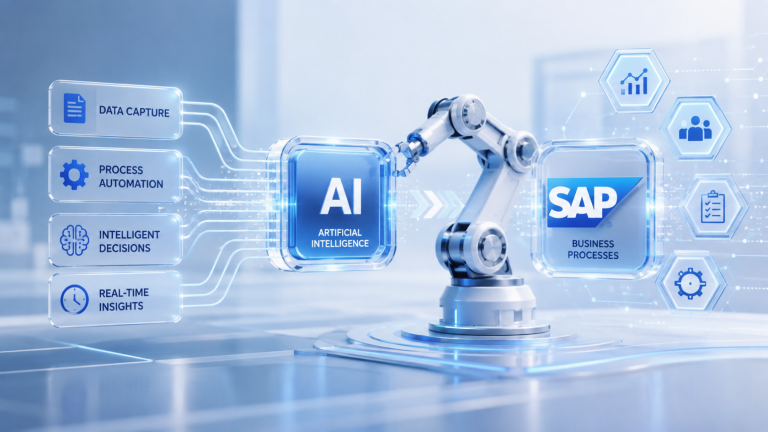
- Connect to your core systems: We help link inspection results with SAP and other enterprise applications, so defect data flows into quality, production, and inventory processes without manual re-entry.
- Build a solid data foundation: Our database and infrastructure expertise supports the storage, performance, security, and availability that image-heavy workloads demand.
- Develop custom applications: From dashboards that show live defect trends to mobile apps for quality teams, we build tools that put insights in the right hands.
- Support and optimize: We provide ongoing support, monitoring, and improvement, so your solution keeps performing as products and conditions change.
Our approach is customer-centric and built on proven standards, with a focus on improving efficiency and reducing operational costs. We see expertise as a journey, and we walk it alongside you.
Building Smarter Quality Control with Vision AI
Vision AI is transforming visual quality inspection from a manual, time-consuming task into an intelligent and automated quality-control process. By continuously analyzing products, identifying defects, and generating valuable data, Vision AI helps manufacturers improve accuracy, consistency, and production efficiency.
As manufacturing becomes more connected and data-driven, integrating Vision AI into production lines can help businesses reduce quality risks, minimize waste, improve operational performance, and deliver greater customer confidence.
The technology is ready. The question is where to begin.
Ready to Bring Vision AI to Your Production Line?
Talk to the EDCS team about your inspection challenges. We will help you identify the right starting point, connect it to your enterprise systems, and turn quality data into measurable results.
Visit www.edcs.co.in or contact EDCS today to schedule a consultation.